

In recent years, more and more homeowners in Sydney and across New South Wales have embraced home battery systems. These systems allow you to store excess solar generation, manage electricity costs, and prepare for blackouts. Among the newer players in this arena is the company ESY Sunhome and its HM6 (or HM5/6) modular battery-inverter system. In this article we’ll explore what the ESY Sunhome battery system offers, how it works in a Sydney home, and what you should consider before installing one.
Since we’re discussing “ESY Sunhome batteries” I’ll keep referring to that phrase so you see what I mean.
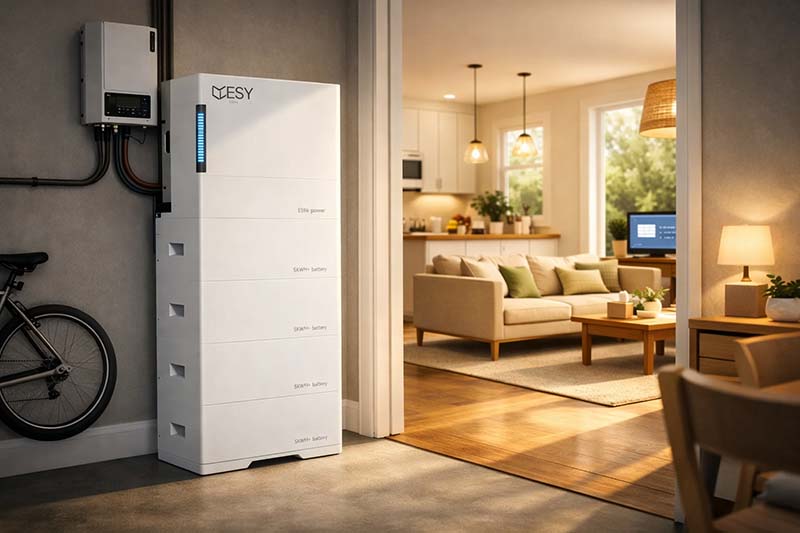
The company ESY Sunhome traces its roots back to manufacturing batteries and battery-management systems in China. According to review sources, it was founded in 2004 and later expanded into home storage solutions in 2024. In Australia, the company has established a presence, including an NSW address in Greenacre. For homeowners in Sydney, the fact that ESY Sunhome has local support and an Australian presence is a strong plus — it suggests better service, installation logistics, and warranty backing.
The HM6 (also referred to within the HM5/6 series) is a modular all-in-one residential energy storage system: battery + hybrid inverter + connectivity.
Key Specs
Monitoring via app; modular design accommodates expansion.
This kind of modularity means that if you’re in a standard suburban home in Sydney and you don’t yet know how much storage you’ll need, you can start smaller and expand later.
If you’re in Sydney or the surrounding suburbs, installing a battery such as ESY Sunhome offers several compelling benefits:
If you’re in Sydney or the surrounding suburbs, installing a battery such as ESY Sunhome offers several compelling benefits:
When you’re in the Sydney market and considering installing a home battery, some practical installation considerations are important.
Single-phase vs three-phase: Many Sydney homes are single-phase, which matches the HM6. If you have a three-phase supply, you’ll need to check compatibility and how much of your load you want backed up. User commentary indicates some complexity around phase imbalance.
Modular expansion: With the HM6, you can size your battery to fit your usage. For example:
Existing solar integration: If you already have rooftop solar, you’ll need to check whether your system is AC-coupled or DC-coupled and how the battery will integrate. Many Sydney installers are experienced with hybrid systems.
Backup circuit configuration: Decide what you want backed up — e.g., critical circuits (fridge, lights, WiFi) or full house. The selection influences wiring and cost.
Space, mounting & safety clearance: Although the system has robust protection (IP66 etc), you’ll need appropriate mounting space (wall or floor), ventilation (if indoor), and adherence to installation standards (clearances, egress, local council/energy network approval).
Warranty, Safety & Standards
A key aspect when buying any major home energy system is the warranty, safety certification, and compliance.
Supply chain & support: ESY’s local presence in NSW (Australia) makes warranty support more approachable than purely offshore brands.
From a homeowner’s perspective, good warranty, strong safety credentials and local support are major bonuses.
Smart systems are increasingly important as home energy becomes more complex (solar + storage + possibly EV + time-of-use tariffs). The ESY Sunhome system brings some modern features:
For a Sydney homeowner, this means that while you have the tools to monitor and control your battery, some advanced “smart” features may be evolving. It’s wise to ask your installer exactly what monitoring/control features will be enabled in your system.
When evaluating battery systems, cost and return on investment are key factors. For the ESY Sunhome system, exact pricing varies depending on capacity, installation requirements, and home energy usage. Instead of fixed pricing, it’s best to request a customized quote for the latest and most accurate price.
In NSW, homeowners may be eligible for certain incentives or rebates depending on factors such as solar system size, installation date, and network tariff. While battery rebates are more limited compared to earlier solar panel incentives, reductions in import costs and evolving feed-in tariffs still influence overall payback.
Financial value typically comes from reducing peak-time electricity use, increasing solar self-consumption, lowering low-value export energy, and gaining additional backup capability during outages.
For Sydney homeowners, it’s recommended to run your own payback assessment by:
Always consult your installer for a detailed, personalized cost-benefit analysis tailored to your home and energy usage.
Here’s a balanced view of the strengths and things to check when considering ESY Sunhome batteries.
Pros
Cons / Things to Check
Return on investment depends heavily on solar generation, usage patterns, and electricity tariff structure in NSW/Sydney.
In short, ESY Sunhome offers a strong package, but as always with home energy systems, the “fit” to your home and usage matters.
Selecting the right installer is just as important as choosing the right battery system. For Sydney homeowners considering an ESY Sunhome battery, Solar World Power
stands out as a trusted, experienced choice. When evaluating your installation partner, keep the following in mind:
Choosing an installer like Solar World Power ensures you maximise the performance, safety, and long-term value of your ESY Sunhome battery investment.
With many battery brands in Australia (e.g., Tesla Powerwall, LG Chem RESU, BYD, etc) it’s useful to see how ESY Sunhome stacks up:
Feature | ESY Sunhome | Tesla Powerwall |
Price | Lower | Higher |
Expandable | Yes | Limited |
App Ecosystem | Basic | Advanced |
Brand Trust | Newer | Established |
Backup Power | Yes | Yes |
If you’re a homeowner in Sydney considering a home battery system, the ESY Sunhome HM6 offers a compelling combination of hardware performance, modularity, resilience and local presence. Its strong points include scalability (5 kWh–30 kWh), a solid warranty, and robust build. While some software/features are still maturing, the fundamentals are sound.
To get the best outcome: choose an experienced installer, match the system size to your home’s usage and solar profile, and keep an eye on your monitoring data. With careful planning, an ESY Sunhome battery system can help you take control of your energy, reduce bills, and build resilience for your home in Sydney.
Depending on the number of modules, usable capacity ranges from about 4.86 kWh (one 5.12 kWh module) up to about 29.18 kWh (six modules) in the HM6 version.
Yes — the system includes a hybrid inverter and backup circuit option, meaning that in a grid outage you can power designated circuits from the battery. However, the extent of backup depends on loads, wiring and installer configuration.
Yes — it’s designed modularly. You can start with a smaller number of modules and add more later up to a limit (around 30.72 kWh in the HM6).
The standard warranty is 10 years or until a specified energy throughput is reached (for example 21,500 kWh per 5.12kWh module).
If you already have a solar system, the installer will assess integration (AC-coupled vs DC-coupled). Some setups may require extra work, but many hybrid inverters support retro-fits. Always check compatibility with your installer.